Project Overview
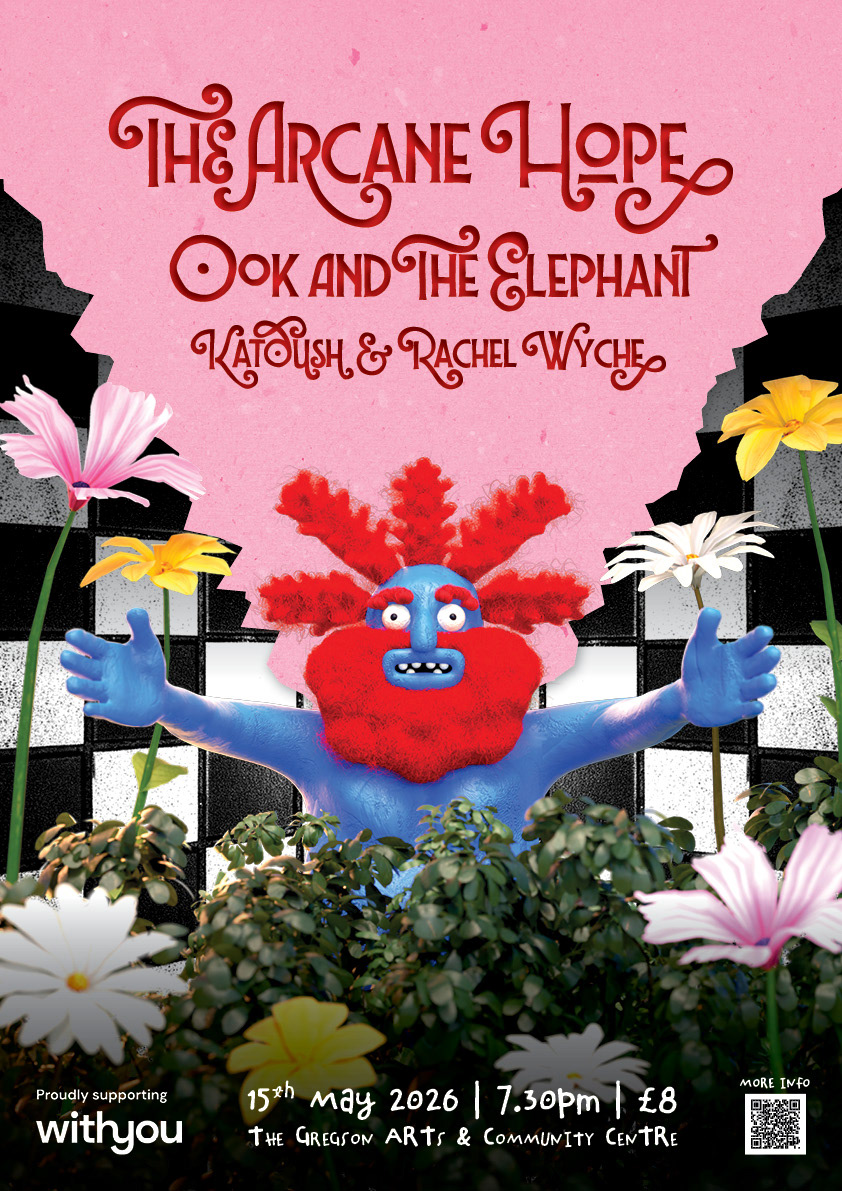
This project explores the concept of Expanded Illustration—a practice that rejects the constraints of the traditional two-dimensional page to treat the digital viewport as a physical stage. Commissioned for The Arcane Hope: Ook and the Elephant at The Gregson Arts & Community Centre, the work explores the friction between the organic and the constructed, bringing together spatial 3D doodling, observed real-world grit, and manual gestural typography.
At its core, the piece is a study in balance: leveraging immersive spatial technology without forfeiting the authenticity, tactile warmth, and deliberate imperfections of the artist's hand.
The Creative Methodology & Pipeline
1. The Spatial Character (VR to 3D)
The central "weirdy beardy" naturalist figure was born as a spatial doodle in Shapelab, allowing the initial form to be sculpted fluidly in virtual 3D space rather than drawn flat.
To bypass the cold, clinical uniformity often associated with standard 3D renders, the sculpt was brought into Blender and layered with tactile, hand-crafted material logic. By assigning clay-like skin volumes and a dense, felt-textured beard, the character takes on the physical weight and presence of a hand-modelled miniature. Emerging from the foliage, the character exists as a friendly, absurd, and naturalistic anchor within the composition.
2. The Observed "Readymade" (Environmental Sampling)
The backdrop relies on an optical readymade: a photograph of a bar toilet floor shot at an extreme, acute period angle. Rather than using digital warping filters, the natural distortion of the camera lens provides an aggressive geometric grid. Re-contextualised behind the character and foliage, this gritty, observed interior acts as a surreal, tiled horizon, creating a direct tension between cold, man-made architecture and organic form.
3. The Human Signature (Vector Hand-Lettering)
To bridge the gap between the 3D volume and the real-world photography, the typography was drawn by hand in Adobe Fresco using an Apple Pencil.
By utilising vector brushes, the letterforms preserve the raw energy, line-weight variations, and honest imperfections of the physical gesture, while providing the mathematical scalability required for publication layout. Assembled alongside paper textures in InDesign, the hand-rendered type acts as the ultimate human signature, ensuring the high-tech elements remain grounded and authored.